







Pages
Get full access on request after purchase
Buy
Portrait of a woman with short dark hair wearing a brown blazer and black turtleneck against a gray background.
Portrait of a serious man with short dark hair and beard wearing a dark blazer and white shirt.
Confident woman with curly hair wearing a beige blazer and pearl earrings against a neutral background.
Smiling woman in a brown cardigan and white shirt gesturing while seated at a desk in an office.
Awarded support
Our experts will assist you.

Let’s talk when it makes sense.

General contact

Questions about next:well, availability, or where to start. If you’re unsure which option fits, this is the right place.

Send a message
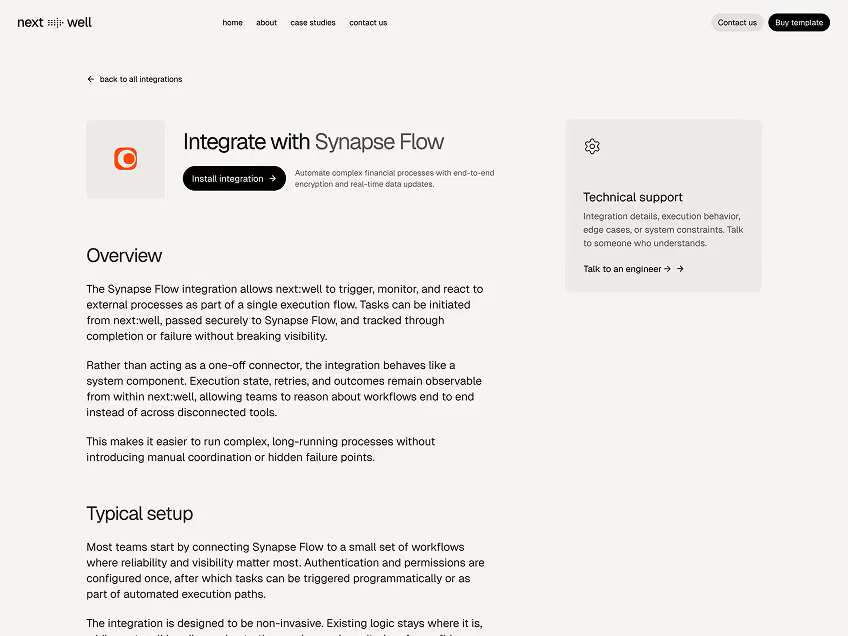
Technical support

Integration details, execution behavior, edge cases, or system constraints. Talk to someone who understands.

Talk to an engineer
Sales & partnerships

For teams evaluating next:well, larger rollouts, or potential partnerships and collaborations.

Send a message
Press & media

Media requests, interviews, brand assets, or background information about the product and team.

Contact press
Social & updates

Follow along for product updates, system thinking, and behind-the-scenes work.

Visit Instagram
Careers & contributors

Interested in working with us or contributing to the system? We’re always open to conversations.

Send a message

System architecture

Orbit is built as a layered platform architecture for digital industrial machines. It connects hardware, vehicle data, software services, operator interfaces and application functions into one scalable system, giving OEMs the flexibility to build the solution they need today and continue developing it over time.

User interface layer

The user interface layer is where the operator interacts with the machine. Orbit can support customer owned user interfaces, CPAC Systems designed interfaces or a jointly developed interface that reflects the customer’s brand, workflows and operator needs.

This gives OEMs full flexibility. They can keep control of the experience themselves, rely on CPAC Systems to design and develop the interface, or work in close collaboration to create an operator environment that feels natural, clear and efficient in daily operation.

Typical interface elements
Digital displays
Touch screens
Machine status views
Camera views
Assistance overlays
Settings and configuration menus
Commissioning workflows

Application layer

The application layer is where machine specific functions are created. This can include situational awareness, operator assistance, productivity tools, digital commissioning, machine guidance and other customer specific functions.

Customers can build their own applications and functions on top of Orbit using their own logic and user interface. CPAC Systems can also develop applications together with the customer’s teams, combining platform knowledge, vehicle integration expertise and the customer’s machine understanding to create the best possible solution.

Typical applications
Situational awareness
Operator assistance
Productivity functions
Digital commissioning
Machine guidance
Customer specific tools and workflows

Software platform layer

The platform services layer provides the shared software functions that make Orbit scalable and efficient to develop on. It can manage data flows, system communication, diagnostics, configuration, user management and connectivity between different machine functions.

By handling common platform logic in one place, Orbit makes it easier to add new features without rebuilding the full system every time.

Typical capabilities
Data routing and processing
Diagnostics and system status
Configuration and parameter management
Connectivity services
Software update support
Security and access control

Hardware layer

The hardware layer provides the physical foundation for the Orbit platform. It can include the Hydra as the central processing unit, together with displays, cameras, sensors, connectivity modules, I/O modules and other CPAC Systems hardware components.

This layer is built to support demanding machine environments, where reliability, integration and long term availability are essential.

Typical components
Hydra central processing unit
Displays and operator controls
Cameras and sensors
Connectivity and positioning
I/O modules and vehicle electronics